Tom Morello Accuses Trump Administration of Using Phrase He Links to Nazi Atrocities
Tom Morello has again publicly criticised the administration of U.S. President Donald Trump, this time accusing it of using a phrase he alleges is historically associated with Nazi mass murder.
The remarks follow the fatal shooting of Renee Nicole Good in Minneapolis last week. Good, a poet and mother of three, was killed by an Immigration and Customs Enforcement (ICE) agent during a large-scale immigration enforcement operation. Her death has since sparked widespread protests across the United States.
Good was reportedly volunteering in neighbourhood patrols aimed at monitoring ICE activity when she was shot while inside her car. Video footage from the incident appears to show her attempting to drive away from the confrontation. Officials from the Department of Homeland Security dispute that account, stating that Good attempted to run over the officer, who they say acted in self-defence.
At a subsequent press conference, Homeland Security Secretary Kristi Noem reiterated the department’s position that the officer’s actions were justified. Shortly afterward, Morello responded on social media, alleging that Noem had stood behind a podium displaying what he described as a Nazi slogan.
The phrase visible on the podium read: “One of ours, all of yours.”
In a social media post, Morello shared claims that the phrase originated during the Second World War, alleging it was first used after the killing of an SS officer in a Czech village, after which Nazi forces reportedly executed all male residents of that village in retaliation.
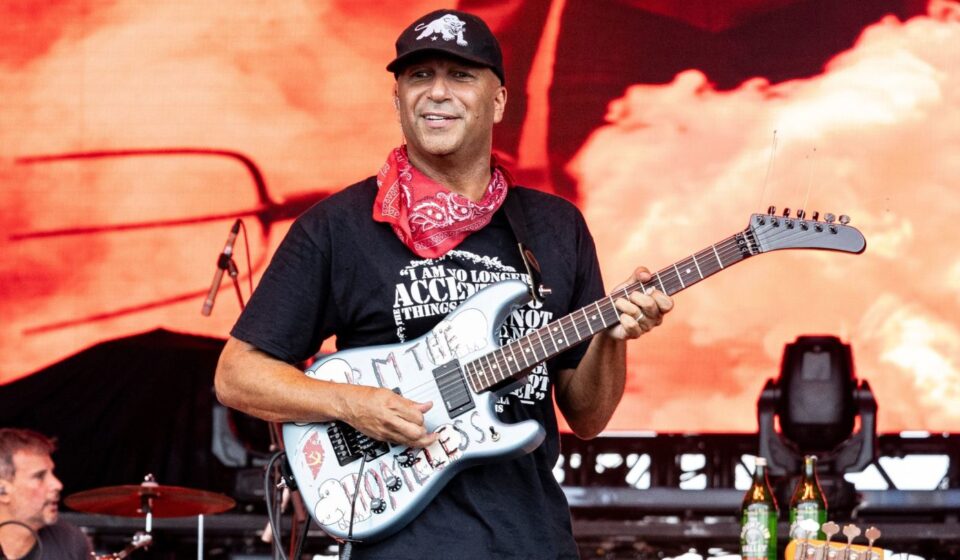
Morello later reposted the allegation alongside an image of himself holding a guitar bearing an anti-Trump message, accompanied by a quote from Ernest Hemingway’s For Whom the Bell Tolls: “There are many who do not know they are fascists but will find it out when the time comes.”
In response to Morello’s claims, the Department of Homeland Security issued a statement rejecting the comparison. The department said that labelling political messaging as Nazi propaganda was excessive and maintained that it would continue using all available communication tools to inform the public about its policies and enforcement efforts.
The controversy also prompted renewed discussion about the historical role of the SS, which oversaw the concentration camp system during the early years of the Nazi regime. Questions have since been raised over whether the phrase cited by Morello can be conclusively traced to that period.
Morello is not the only public figure to criticise the Trump administration in connection with Good’s death. Actor Mark Ruffalo used a recent awards ceremony to protest ICE, describing Trump as the “worst human being” and wearing a pin bearing the words “BE GOOD” in tribute to Renee Nicole Good.
Ruffalo said the pin was intended to honour Good, whom he described as having been murdered, and criticised what he characterised as unlawful military and immigration actions under the Trump administration. He further questioned the moral authority of the president, citing Trump’s criminal conviction and warning of broader consequences for U.S. leadership.
Comedian Wanda Sykes also appeared at the event wearing a protest pin and called for public opposition to what she described as a rogue government. In the days following the shooting, musician Billie Eilish re-shared a post referring to ICE as a terrorist organisation, which prompted a response from government officials.
A spokesperson for the Department of Homeland Security said that recently released footage supported the department’s account of the incident, claiming that Good had obstructed law enforcement and attempted to use her vehicle as a weapon. Officials stated that the public could review the footage and form their own conclusions.
Morello has repeatedly criticised Trump and U.S. immigration enforcement agencies in the past. He has participated in anti-ICE protests, released politically charged music addressing immigration policy, and collaborated with other artists on protest-themed projects. His recent work continues to reflect a strong opposition to ICE and broader U.S. immigration enforcement practices.