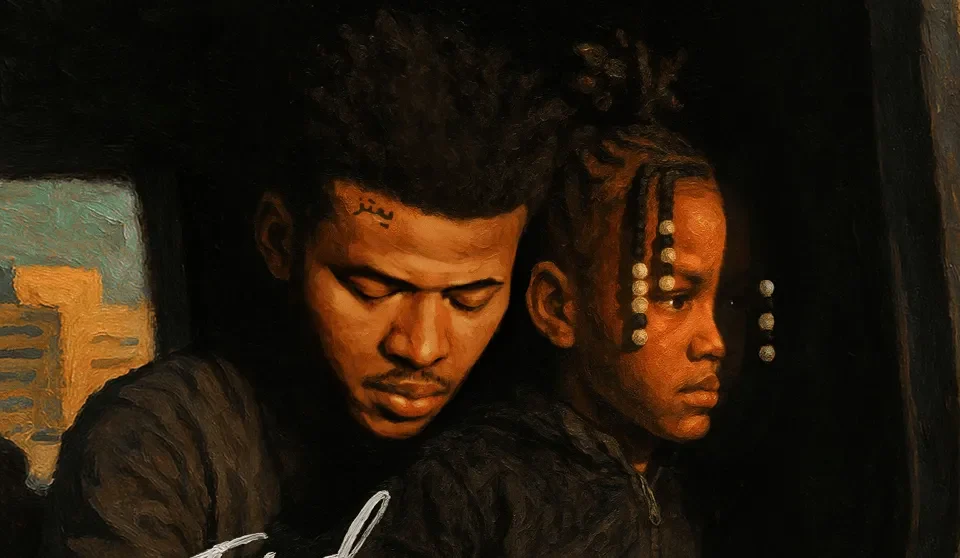
KP Skywalka — I Tried to Tell You
2025
KP Skywalka opens the emotional heart of I Tried to Tell You on “Hell or Not,” the album’s second-to-last track, by asking a question that lingers over the entire record: “What am I supposed to do?” His voice flickers in and out, blurred like an unreliable memory, while a sample of Erykah Badu hums nearby, evoking the feeling of riding quietly in the backseat of a parent’s car. From there, the southeast DC rapper drifts between eras and states of mind—checking whether a younger friend is “ready to war up,” mocking rappers flexing weapons they’ve never used, and reminiscing about leaner times when survival meant stretching noodles and Spam. Images of a collapsing Beltway reality collide with moments of tenderness, all delivered through KP’s restless, drill-inflected cadence. The past doesn’t feel distant here; it feels uncomfortably close.
KP’s commitment to the DMV’s evolving drill sound—marked by breathless punch-ins and dense, unfiltered narration—has only deepened as he’s tested the edges of the style. Projects like 4 Tha Freakas and 2023’s Rhythm N Bip leaned heavily into explicit territory, pairing smooth R&B flips with hedonistic player anthems that reveled in excess. Even when he aligns with peers such as Skino or SlimeGetEm on darker, more conventional Free Car Music tracks—grim street vignettes over springy, ominous beats—KP stands out as a vivid storyteller. His bars are packed with detail and personality, though the approach can occasionally flatten into predictability, a common pitfall of this drill lineage.
I Tried to Tell You sidesteps that trap by constantly shifting perspectives, sounds, and emotional registers. Rather than staying boxed into regional expectations, KP stitches together memories of family, love, violence, and hustle across a sonic palette rooted in Black soul traditions. The album feels less like a refinement of a formula and more like a genuine experiment—an argument for what meaningful risk-taking can look like within the DMV underground.
The 20-track runtime, a sharp contrast to the quick-hit nature of 4 Tha Freakas, gives KP room to wander. The production—handled by a rotating cast including Turn Me Up Pro, Yoyotheproducer, and Tavaras Jordan—sounds intentionally archival, as if KP is reconstructing the soundtrack of his upbringing. On opener “Industry,” he croons over a woozy H-Town sample, conjuring memories of car rides to Wizards games. “Nuntoloose,” his plugg-tinged collaboration with 10kdunkin, frames his laid-back delivery with Anita Baker’s unmistakable voice. Go-go’s influence pulses through “VPN,” where jittery drums shuffle beneath a funky, jazz-leaning sax sample, and KP bends his flow to match the groove. Elsewhere, the angelic choir on “Streets Sing to Me” slows his rapping to a near standstill, while “A Drop Out” feels like a warped R&B single from the late ’90s—something that could’ve lived on a TLC 12-inch, stretched thin by time and heartbreak.
Though much of the album is delivered in the hardened language of modern DMV drill, KP’s sensibility is rooted in the slow-burn storytelling of Southern rap. His world-building on I Tried to Tell You recalls the meticulous autobiographical approach of Pimp C—scenes unfolding with specificity and intent. He sketches moments like racing through red lights with his cousin and daring each other toward violence (“Scared Like Steele”), or bouncing up and down the Northeast Corridor before sunrise (“Latenight”). Certain phrases repeat like verbal tics—his endless variations on “bip” scattered everywhere—but subtle shifts in cadence and tone keep them from feeling stale. Even when lines veer toward the routine (“I’m blowing up but I’m stuck in a warzone”) or the disturbingly casual (“I can talk about murder in music because I really done it”), his delivery injects them with uneasy life.
At the core of the album is the friction between KP’s emotional vulnerability and the armor he’s built to survive. On “See My Wrongs,” he begins with disarming hope—“Know it’s some good in the nigga hope that she sees it”—before calmly detailing how he helped someone else chase a violent dream. “Made It Out” juxtaposes a memory of a clean headshot with a halting confession, his voice catching as he wonders whether grief has left him “d-depressing.” Even when paranoia colors his thoughts on fatherhood and family in “Heaven Sing,” there’s space for fleeting warmth—like remembering a neighborhood girl showing off a belly ring during the summer. When these contradictions surface, KP often slips into a higher, melodic tone, as if he needs his truths to echo beyond their own inconsistencies.
What ultimately keeps I Tried to Tell You alive is KP’s instinctive understanding that rules are meant to be bent—or ignored entirely. On “Itty,” gunshot ad-libs chatter in the background like an internal argument. His collaboration with Skrilla plays out like hostile territory, both rappers gliding over calypso rhythms while trading their regional slang. Guest appearances from DC’s Skino and Philly’s Lil Hawa are given real breathing room, not just token verses. And when KP circles back to familiar player-anthem territory—snatching girls, bruising egos—it doesn’t feel like repetition for the sake of momentum. It sounds immediate, like something that happened moments before the booth door closed.
The album’s final moments linger. On closer “Pockets Flat,” after reflections on money and enemies, KP drops a line that cuts through everything else: “Ain’t see grandma in two months, like she want see my face.” His voice is treated to sound distant, fading into space. The balance he’s walking—between tenderness and brutality, nostalgia and survival—remains unresolved. The wire is still tight.