Out the Blue – WNC WhopBezzy & 70th Street Carlos
2025
There’s a scene in the 2010 Baton Rouge street movie Ghetto Stories—basically Trill Entertainment’s low-budget answer to The Fast and the Furious—that perfectly captures the spirit of the city’s rap culture. Boosie and Webbie play rivals from opposite ends of town, constantly barking threats at each other, trading insults with the kind of exaggerated intensity that makes every line unintentionally hilarious. What neither knows at first is that they share the same OG: Slimm, a drug kingpin with a code, even if his personal life is messy. When Slimm is suddenly killed, the two enemies are forced to put aside their beef, team up, and carry on his mission—whatever that actually means. The middle stretch of the movie is basically a tribute to male bonding: strip clubs, hustling, cooking up, flexing, and yes, even a makeover montage. Watch it once and the lesson is clear: in Baton Rouge rap, loyalty outweighs everything.
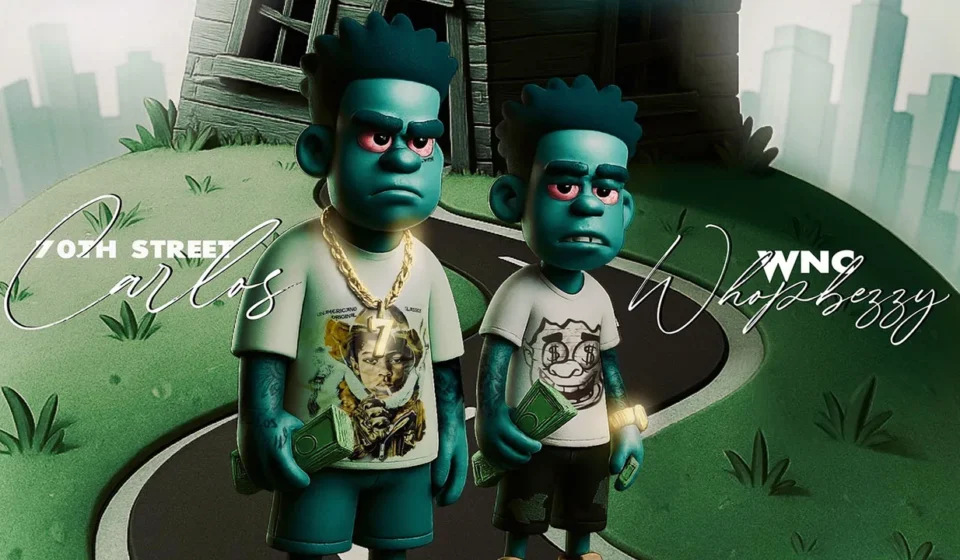
That emphasis on brotherhood helps explain why the city has produced so many notable rap pairings over the years. Beyond Boosie and Webbie, there were duos like Scotty Cain and Mista Cain, TEC and Maine Musik, and now, firmly in that lineage, 70th Street Carlos and WNC WhopBezzy. According to their origin story—a tale you’re free to doubt, but one that’s too good not to enjoy—the two met in first grade. Bezzy supposedly walked into class already iced out, flashing gold teeth, rocking a chain, and attracting attention like a local celebrity. Carlos clocked him immediately and thought, “This little dude really like that.” From then on, they were inseparable.
Years later, in the mid-2010s, long before either was taking rap seriously, Bezzy was tattooing Carlos, and the idea to make music together came almost by accident. A string of singles and a joint mixtape in 2017 put them on the radar during an especially competitive moment in Louisiana rap, when names like NBA YoungBoy, JayDaYoungan, and Kevin Gates were reshaping the state’s sound. Then, just as quietly, Carlos and Bezzy stopped releasing music together, with no real explanation. Now, with Out the Blue, they’re back—and they sound like they never left.
The tape delivers exactly what longtime listeners would expect: Carlos and Bezzy talking reckless, chasing money, navigating small-time beefs, juggling fatherhood, and generally living loud. More than anything, it’s packed with booming, bass-heavy club records built to rattle trunks and shut down Louisiana dance floors. The energy is playful but aggressive, like a duo with a long memory and unfinished business. On “Fall in Line,” Bezzy barks commands in a raspy, half-shouted voice that sounds like he blew it out screaming over the DJ booth. The song feels less like a rap track and more like athletic conditioning—pure adrenaline. “Rappin & Trappin” leans into handclaps and call-and-response chants, with Bezzy channeling old-school Juvenile energy as he orders bodies to move. On “DYS,” Carlos crashes the party, unloading threats at anyone they’ve got issues with, punctuating bars with explosive sound effects like he’s playing war in the studio.
It becomes clear pretty quickly that Carlos is the wild card. His approach is chaotic in the best way: unpredictable ad-libs, flows that switch mid-bar, and a general refusal to settle into one rhythm for too long. On “Up Wit Me,” he sounds like he’s arguing with himself, bouncing between calm delivery and full-on vocal mayhem—lip-flapping noises, wrestling-style yelps, and a distorted yell-rap that makes him sound barely contained. It’s messy, but it’s magnetic.
Still, Carlos isn’t just a loud presence. He’s capable of reflection without killing the momentum. On “Mail Man,” he slides personal moments—like snippets of conversations with his mother and blunt acceptance of mortality—right alongside braggadocious, unapologetic sex talk. Bezzy, meanwhile, plays the stabilizing force. His hooks and more straightforward rhyme patterns keep the tape from flying off the rails, even if a few moments—like the overly generic sing-rap on “10 x 5”—feel less inspired. Years ago, that balance sometimes made Bezzy feel overshadowed, but here it feels necessary. Carlos’ chaos sharpens Bezzy’s timing, while Bezzy’s grounding presence keeps Carlos focused. You hear it in small moments: Bezzy’s amused “uh huh” ad-lib powering up a verse, or the way he roasts someone’s toughness and weak window tints in the same breath on “In the Mix.” Given how much of their music revolves around cruising Baton Rouge in muscle cars, the tint diss might actually sting more.
What really locks the duo together, though, is their shared reverence for Louisiana’s club-driven legacy. In a Southern rap landscape increasingly dominated by moody piano loops and introspective pain narratives, Out the Blue feels refreshingly physical. This is music made for packed venues, sweaty nights, and nonstop movement. Whether they’re flexing over throwback Trill-style funk on “No Talking,” or speeding up a classic B.G.-inspired groove on “WTF,” Carlos and Bezzy sound most alive when they’re leaning into that ass-shaking tradition.
Their take on L.O.G.’s “G’s & Soldiers” might be the purest example. Over a menacing, mid-’90s Mannie Fresh–style bassline that feels like bounce music scored for a crime mystery, they sound like they’re freestyling outside the club, half-drunk and fully confident. Bezzy drops absurdly funny lines, Carlos croons like he’s still holding onto a bottle smuggled out of VIP, and the whole thing feels loose, joyful, and unfiltered.
At its core, Out the Blue isn’t about innovation or reinvention. It’s about chemistry—the kind built over years, arguments, silence, and shared history. Carlos and Bezzy don’t just rap together; they move like brothers who understand each other’s timing, flaws, and strengths instinctively. And in Baton Rouge, that kind of bond isn’t just respected—it’s everything.