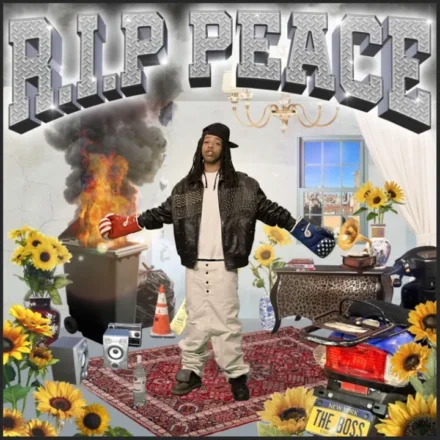


Liim’s “R.I.P. Peace” Is Just So New York
When a preview of Liim’s new track “R.I.P. Peace” surfaced on Instagram last week, it triggered an immediate sense of recognition—like a name half-remembered from the edge of a crowded night out. The writer recalls attending a Gil Scott-Heron tribute at S.O.B.’s last April, featuring performances by Pink Siifu and Liv.e, where a young supporting artist—then unfamiliar—likely performed unnoticed. It is the kind of moment that only reveals its significance in hindsight: a reminder that the opening act you overlook today might be the one you can’t escape tomorrow.
What makes “R.I.P. Peace” so compelling is its texture and atmosphere, built on a bassline so dense and weighty it feels almost tangible. The track carries an aesthetic that nods to early-internet visual culture, recalling the hazy nostalgia of Blood Orange’s “Champagne Coast” era. Its foundation draws inspiration from and interpolates J Mack’s “Go Stupid,” a local New York party staple, while unfolding as a vibrant, conversational tribute to Harlem and the city at large—rich with street-level references like the M103 bus, C-Town supermarket, and Levels Barbershop on 125th Street.
The song’s title itself carries a layered story. Originally dedicated to a barber named Peace at Levels—believed to have passed away—the narrative shifted after Liim learned the misunderstanding was rooted in distance rather than loss. Peace, according to a voice note from Liim, had simply moved to Albany. The meaning of the title evolved with it, reframed as a playful reinterpretation: “Rise in Power Peace.”
Sonically, the track balances nostalgia with warmth. Its production shimmers with airy, almost celestial touches—swooping harps and a chorus that lands with the innocence of childhood chants, evoking a sense of collective memory that feels both personal and communal. The energy recalls the carefree pulse of early-2000s New York, where local anthems doubled as cultural shorthand.
There is a distinctly communal joy running through the record, especially in its subtle nods to borough life and transit rhythms, the kind of sonic geography that instantly locates you within the city’s fabric. Even the shoutouts feel intentional, grounding the track in lived experience rather than stylized nostalgia.
Ultimately, “R.I.P. Peace” captures New York as something both specific and expansive: playful but rooted, nostalgic yet present-tense. It reflects a city that is constantly referenced, reimagined, and re-sounded—never fully fixed, always in motion.