

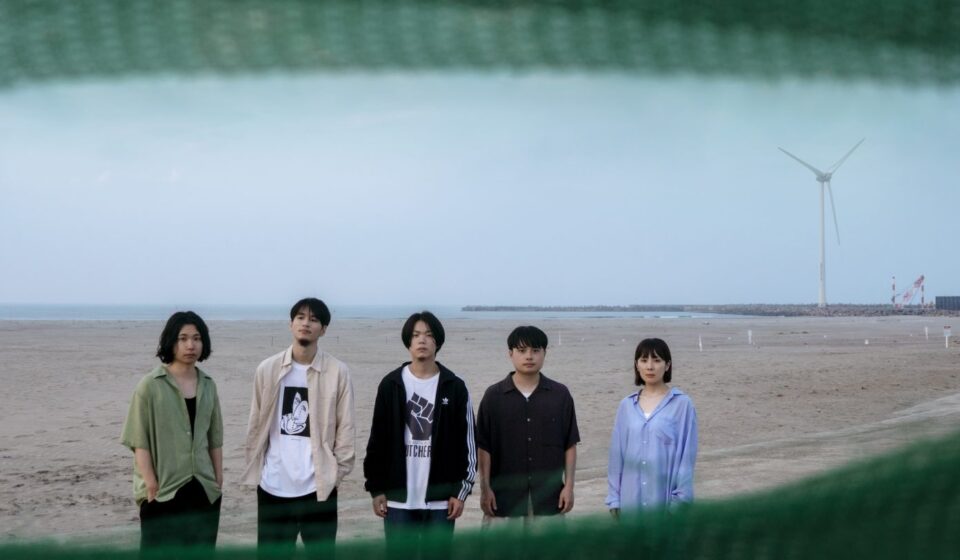
Kurayamisaka spin heartfelt, blown-out euphoria from Japan’s restless underground
A band is rarely a single, tidy story. More often, it’s a volatile gathering of different lives moving in and out of sync — and Kurayamisaka understand that better than most. Even as the five-piece surge toward the top tier of Japan’s most talked-about indie acts — sparking endless genre arguments online, lighting up stages at Fuji Rock, and sharing bills with era-shaping names, all within a surreal three-year burst — their rise wasn’t something anyone could have confidently predicted. In fact, Kurayamisaka were born out of what felt like an ending.
Their origin traces back to university, when vocalist Sachi Naito — then writing songs with a J-pop sensibility — started a band with guitarists Ryuji Fukuda and Shotaro Shimizu. “It was just the impulse of youth,” Naito says, speaking over Zoom from Japan. As time passed, adulthood arrived with its usual weight: jobs, schedules, responsibilities. Eventually, the project stopped.
But the idea didn’t fully disappear, especially for Shimizu. After spending roughly a decade playing across Tokyo’s venues — by his own description, doing it at “150 per cent capacity” — he reached a point where trying again felt possible. Convinced he could help “draw out Naito’s potential,” he contacted her once more, this time stepping into the role of songwriter himself. He recruited bassist Asami Rinpei, previously part of the Yokohama emo band Yubiori, and found drummer Yousuke Hotta online. Word eventually reached Fukuda, who swiftly returned, completing the lineup as a third guitarist. “It felt like fate,” he says.
With a three-guitar setup giving them a bigger bite, Kurayamisaka quickly carved out a sharper, stranger edge. Starting with their debut single “Farewell” in 2022 and continuing on the EP Kimi Wo Omotteiru (I Am Thinking Of You) — written from the viewpoint of two girls facing separation after graduation — Naito’s fragile, disappearing voice became the thread running through the band’s melancholic alt-rock. Their songs were steeped in shadowy, poetic atmosphere, driven by feedback, distortion and noise that wasn’t decoration so much as emotional weather.
Sometimes their sound swelled into something cinematic and grand, while other tracks hit with a darker urgency, but the core remained the same: ghostlike melodies pressed up against towering walls of guitar. That combination spread quickly, drawing attention both inside Japan and far beyond it. After the EP — soaked in distortion and heavy with feeling — listeners online began tagging the band as shoegaze, while their initially elusive presentation only added fuel. They kept personal details out of view and leaned on illustrated artwork, leaving space for people to invent their own myths about who they were.
Shimizu remembers the first wave of speculation that took hold online. “People would say things like, ‘This is definitely some long-lost band from the ’90s! The members all seem like they’re already dead!’ Or, ‘This has to be AI!’” At the beginning, the fog was partly by design. Shimizu originally imagined Kurayamisaka as a side project, assuming everyone would be tied up by other commitments. “It really did feel like we were pulling a prank,” Naito says.
Still, they couldn’t keep the secret sealed for long. They were too excited to see how people would react once the truth surfaced. Before long, as Kurayamisaka started playing their first shows, they stepped into the light and revealed themselves the old-fashioned way — by appearing onstage, loud and real.