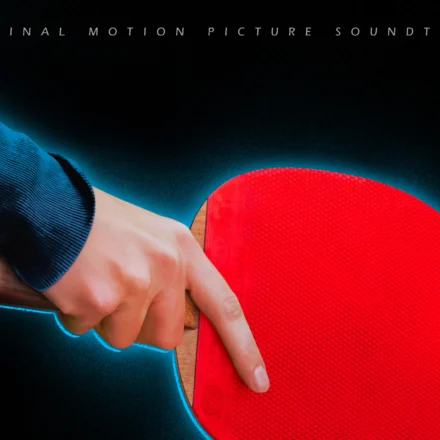
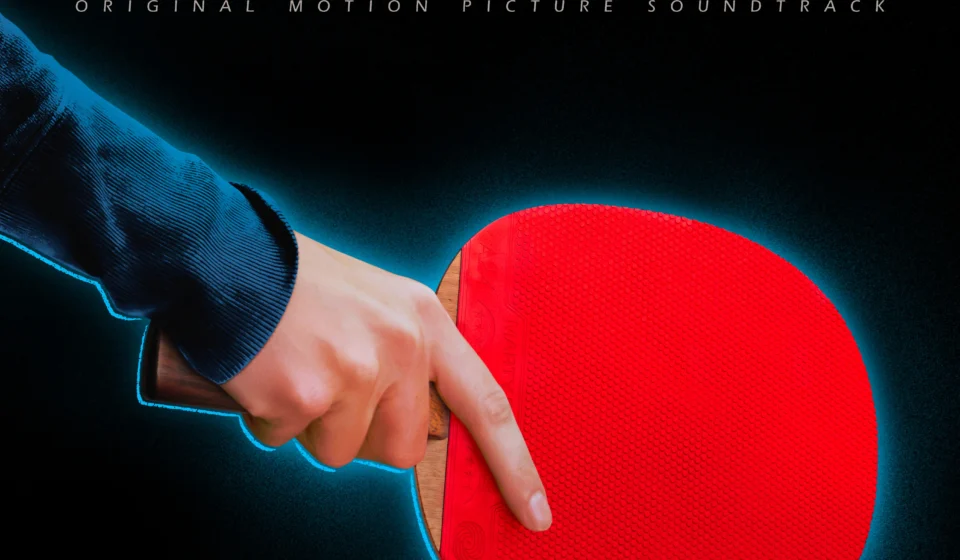
Marty Supreme — Original Motion Picture Soundtrack
2025
Daniel Lopatin doesn’t simply compose music for Josh Safdie’s films—he creates alternate dimensions inside them. In Good Time and Uncut Gems, his obsession with kosmische electronics wrapped frantic, dirt-under-the-nails stories of modern excess in the glow of a mythic past. Sterile hospital corridors shimmered like scenes from Thief, while New York’s diamond district felt as perilous as the fever-dream terrain of Sorcerer. Rather than echoing sci-fi touchstones like Blade Runner, Lopatin’s scores tunneled into the psychology of the Safdies’ characters, immersing the audience in their compulsions and inevitable self-destruction. When Howard Ratner finally “wins,” the music doesn’t resolve neatly—it ascends, filling the air with radiant flutes and Mellotron swells, as if the gates of heaven briefly cracked open.
That sense of heightened unreality has always bordered on the absurd, but with Marty Supreme, Lopatin pushes the effect outward instead of inward. Safdie’s latest film follows a fiercely ambitious young Jewish table tennis prodigy in the early 1950s, played by Timothée Chalamet, who believes his destiny is not just personal glory but national triumph. As Marty barrels forward, propelled by faith in himself and the mythology of America, the soundtrack detonates with a parade of ’80s pop anthems—songs that feel futuristic to him and deeply nostalgic to us. Tears for Fears’ “Change” fires the opening like a starting pistol. Tracks by Peter Gabriel and New Order spin the film into what feels like a never-ending training montage. And Alphaville’s “Forever Young,” used at a crucial juncture, reframes Marty’s obsession with legacy in devastating fashion.
Here, music is not background—it’s a protagonist. It’s as bold, restless, and irresistible as Marty himself. While Lopatin has long been fascinated by the commercial sheen and sci-fi sentimentality of the 1980s, his earlier film scores often hovered near homage. In Marty Supreme, that fascination finally crystallizes into something larger and more cohesive. Lopatin matches the film’s outsized ambition with a sound world that feels total, immersive, and relentlessly alive.
Drawing on his recurring fixations—media decay, cultural memory, and temporal dislocation—Lopatin builds a lush, disorienting sonic environment that mirrors the Fairlights, DX7s, and Synclaviers threaded through the film’s pop selections. The arpeggio once again serves as the engine, refined through years of experimentation dating back to Rifts. Shimmering, new-age flutes reminiscent of R Plus Seven drift through tracks like “The Call” and “The Apple,” bathing Marty’s rise in iridescent optimism. Then “Endo’s Game” yanks everything downward with the menacing, pulsing low end associated with Garden of Delete.
“Holocaust Honey” transforms the spiritual calm of Constance Demby’s “Novus Pt. 2: The Flying Bach” into a swirling carnival of organs, choirs, and strings, amplifying a dreamlike flashback until it feels as vast and disquieting as Koyaanisqatsi. Lopatin’s increasingly theatrical instincts—sometimes overwhelming in his solo work—find perfect balance here, elevating the film into something monumental and uncanny.
As Marty’s journey stretches across borders, the score travels with him. When Japan emerges as both obstacle and mirror in Marty’s quest for dominance, Lopatin nods to the country’s own rich electronic lineage. The exaggerated, almost cartoonish march of “Marty’s Dream” and “Pure Joy” echoes the playful grandeur of Yasuaki Shimizu’s Music for Commercials. Elsewhere, “Motherstone” introduces fluttering marimbas in the vein of Midori Takada, layered with saxophone and fretless bass that could have been lifted from an old Prism record. These mallet tones recur throughout the soundtrack, ricocheting through moments of mounting tension. Lopatin has noted the poetic symmetry here: table tennis itself is a game of ball and stick, a rhythm endlessly repeated.
While the score hits hardest in the context of the film, it stands confidently on its own. Free from dialogue snippets and ambient filler, the album maintains a constant nervous momentum that mirrors the movie’s breathless pace. It oscillates between hypnotic, tongue-in-cheek pieces like the organ-drenched “Vampire’s Castle” and hazy fusion excursions such as “Rockwell Ink” and “The Necklace.” The sequencing is meticulous, delivering the satisfaction of a fully realized electronic album rather than a stitched-together soundtrack. When “The Real Game” erupts with marimbas popping like fireworks, it feels just as climactic without images attached.
Lopatin has always been interested in warping familiar cultural forms into something alien. With Marty Supreme, he does exactly that to the sports drama—dismantling its clichés and reassembling them as a psychedelic meditation on obsession, ambition, and national mythmaking. The film becomes a cosmic reimagining of Rocky, spanning everything from Cold War anxiety to ancient monumentality, all in service of humanity’s urge to chase the impossible regardless of cost.
Lopatin’s music is essential to that vision, especially in the final moments. “Force of Life” reframes the film’s ideas about aspiration, capturing how dreams can feel infinite and hollow at the same time. It’s an audacious gamble, executed with precision and confidence. And like Marty himself, it commits fully to the leap—and sticks the landing.