Radiohead Live Review: Feeling It, Standing Still, Moving Anyway
Radiohead find themselves in an unfamiliar position. For the first time since their debut more than three decades ago, they are touring without any new or even recent material to anchor the experience. A band long defined by reinvention, restless experimentation, and a sense of constant forward motion is now paused—looking backward, reassessing, and, at moments, visibly unsure of where they stand. It’s easy to forget how dramatically their pace has slowed: nearly ten years have passed since their last album, and only two studio records have emerged since In Rainbows in 2007.
Recent public comments have only reinforced the sense of uncertainty surrounding the group. They have acknowledged that there are no new songs waiting in the wings and no concrete plans beyond this tour. One member openly admitted he nearly walked away from the band entirely. Others had gone years without speaking. For the first time, they are touring with separate dressing rooms—small details, perhaps, but telling ones.
Add to this the ongoing scrutiny surrounding the band’s political positioning, particularly related to Israel and Palestine, and the context around this tour becomes heavier still. Calls for boycotts, public criticism, and accusations of silence or complicity have followed them from city to city. The irony of this pressure—given Radiohead’s long-standing artistic fixation on free expression, censorship, and moral unease—has not been lost on observers. Altogether, these elements do not suggest a band operating at a peak of confidence, either creatively or personally.
Against that backdrop, the decision to stage the tour “in the round,” with a small circular platform at the center of the venue, feels deeply symbolic. Rather than projecting outward, the band pulls inward—literally placing themselves closer together, perhaps in an attempt to rediscover balance, connection, or simply a shared center of gravity.
In Madrid, on the opening night, none of that tension was obvious at first glance. Outside the venue, the mood was celebratory, even buoyant. Inside, the same energy carried through. There was a genuine sense of unpredictability about what the night might bring. During rehearsals, the band reportedly revisited every album from The Bends onward, building a pool of more than 60 songs to rotate through. This could have resulted in a greatest-hits retrospective—or a stubborn dive into obscurities. In classic Radiohead fashion, they chose a third path.
They appeared on stage almost casually, slipping straight into “Let Down.” In today’s strange cultural loop, the song has taken on a new life, embraced by a younger generation and circulating widely online, even as the band themselves face increasing criticism elsewhere. Wrapped in circular screens that projected distorted live visuals, they were at first barely visible. The song unfolded slowly, layered guitars shimmering as the crowd erupted.
Early on, moments of rust were hard to miss. “2 + 2 = 5” and “Sit Down. Stand Up.” wobbled slightly, rhythms struggling to fully lock into place. Still, the sheer force of the sound—deep, physical bass and cracking drums—made the imperfections easy to forgive. “Sit Down. Stand Up.” in particular veered into thrillingly strange territory, its jittery structure almost morphing into something resembling drum’n’bass. It was one of the closest the band has come to outright club music.
Initially, the screens felt distancing, reinforcing the band’s long-standing themes of alienation. But once the visuals pulled back to fully reveal the group, the reaction was explosive. The production soon made sense: intimate yet flexible, allowing the band to cluster together or roam the stage, turning to face different sections of the audience. Thom Yorke’s angular, spasmodic dancing—twisting, jerking, spiraling—was very much back, as expressive and awkward as ever.
The early stretch of the set was uneven in mood and momentum. A gently uplifting “Lucky” gave way to a heavier, slightly sluggish “Ful Stop,” before the looming tension of “The Gloaming” took over. Then something clicked. What followed was a sustained run of astonishing power and precision.
“Myxomatosis” hit hard, all crunch and pressure. “No Surprises” sliding into “Videotape” delivered a devastating, hushed melancholy. “Weird Fishes/Arpeggi” was nothing short of breathtaking, the band locked into a twisting, relentless groove. From there, the sequence of “Everything in Its Right Place,” “15 Step,” and “The National Anthem” felt like Radiohead at full imperial strength—dense yet nimble, explosive yet controlled.
The band seemed most alive when playing material from In Rainbows and Hail to the Thief. Yorke visibly braced himself for “A Wolf at the Door,” punching the air before unleashing feral, cathartic howls. The encore, however, was more conflicted. “Fake Plastic Trees,” while beautifully rendered, felt slightly out of place—a graceful nod to an earlier version of the band rather than a fully integrated part of the night’s emotional arc.
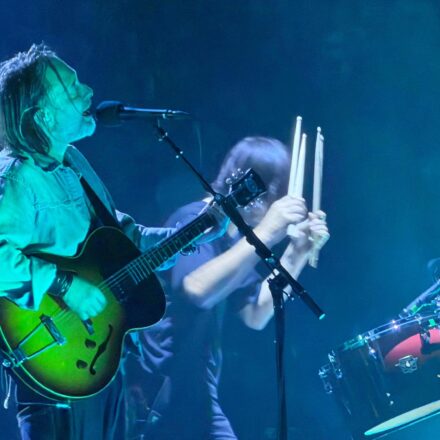
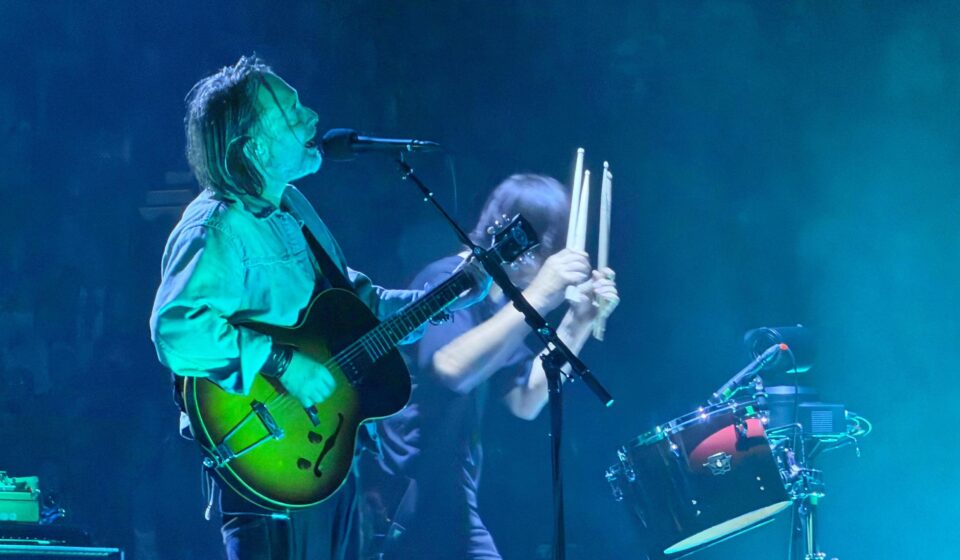
Momentum returned with “Paranoid Android,” and peaked again during “There, There,” when multiple members took up drums, surrounding the rhythm in a way that felt ritualistic and communal. For the final song, “Karma Police,” they gathered closer than they had all evening, delivering a version that was euphoric, unified, and emotionally charged.
It sounded like a band rediscovering something vital—connection, purpose, trust—but also like one still standing on the edge, unsure whether to step forward or remain suspended in place.
Setlist
Let Down
2 + 2 = 5
Sit Down. Stand Up.
Bloom
Videotape
Lucky
Ful Stop
The Gloaming
Myxomatosis
No Surprises
Videotape
Weird Fishes / Arpeggi
Everything in Its Right Place
15 Step
The National Anthem
Daydreaming
A Wolf at the Door
Bodysnatchers
Idioteque
Encore
Fake Plastic Trees
Subterranean Homesick Alien
Paranoid Android
How to Disappear Completely
You and Whose Army?
There, There
Karma Police