

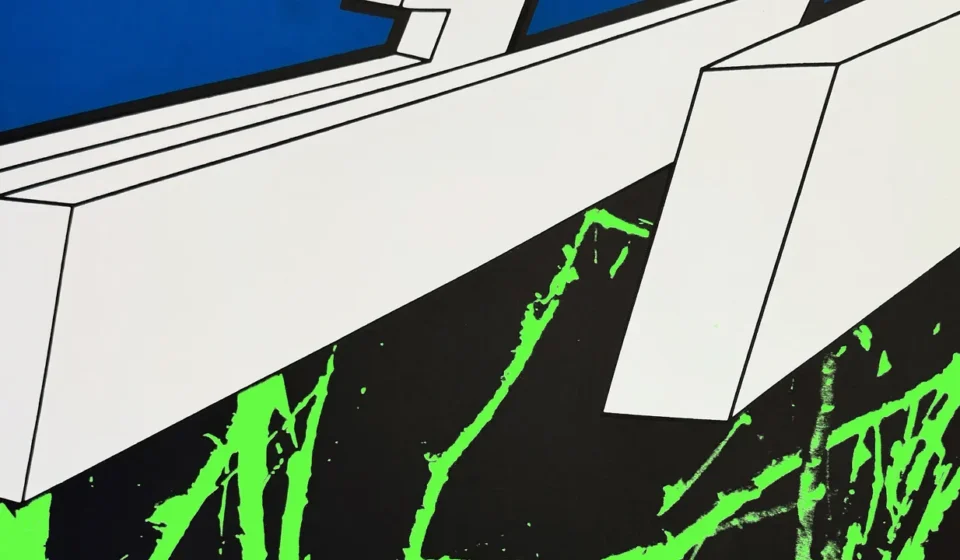
Tranquilizer – Oneohtrix Point Never
2025
Roughly fifteen years ago, Daniel Lopatin made what might still stand as the most inspired impulse purchase of his career. While browsing online, he stumbled upon a seller offering bootleg DVD compilations packed with old television commercials—ads lifted from Saturday morning cartoons, afternoon soap operas, and late-night cable programming. The discs were full of relics: Wrigley’s gum spots, Hershey’s chocolate jingles, Heinz Alphagetti promos. The sound was unmistakably dated—cheap synthesizers, syrupy melodies, the soft distortion of VHS tape. For Lopatin, whose work has long been drawn to the cultural leftovers of the late 20th century, this archive of discarded media was irresistible. He bought the DVDs, extracted the audio without even bothering to watch the footage, and fed fragments into his sampler. From that process emerged Replica: a ghostly, emotionally complex collage of ambient miniatures that remains one of the defining electronic albums of the 21st century.
The foundation of Tranquilizer, Lopatin’s latest release under the Oneohtrix Point Never name, follows a surprisingly similar path. This time, the source material came from commercial sample CDs he discovered on the Internet Archive in the early 2020s. He bookmarked them with a loose plan to return someday. Then, without warning, the files vanished—likely casualties of a copyright takedown—and Lopatin moved on. When they resurfaced later, their disappearance and reappearance became central to his thinking. The fragility of the archive itself, the sense that everything can be saved and yet nothing is guaranteed to last, took on emotional weight. Lopatin has said he wanted to bottle that feeling: the atmosphere of an era where culture is endlessly preserved and endlessly slipping away at the same time.
This fascination with unstable memory and mediated history isn’t new for him. Magic Oneohtrix Point Never (2020) revolved around another found archive, using radio “format flips”—the jarring transitions when stations abruptly switch genres—as its organizing metaphor. Again (2023) staged a dialogue between Lopatin’s present-day sensibilities and his younger creative self, probing how taste evolves and mutates over time. Even earlier, albums like Age Of and Garden of Delete wrapped their music in elaborate conceptual frameworks, from surreal mythology to fictional bands and invented online lore. By contrast, Tranquilizer feels comparatively unencumbered. Its ideas are present, but they don’t announce themselves loudly. The album doesn’t lean on an overt narrative or a rigid intellectual structure.
Sonically, Tranquilizer occupies terrain familiar from Replica: a shifting, uneasy blend of glossy new-age synth tones, immense sub-bass swells, stray bits of strings and woodwinds, and oddly lopsided rhythms formed from imperfectly chopped loops. But unlike earlier projects, the origin of these sounds rarely demands attention. Sample libraries are typically utilitarian—designed for film scores, advertising, or festival-sized EDM—but Lopatin seems less concerned here with decoding their cultural baggage. Instead, he treats them as raw material, guided more by instinct than analysis. The result is an album that may be his most immediately inviting in years, despite its density and complexity.
The opening moments set the tone. A wash of wind fades in, joined by distant chimes and the slow shimmer of a 12-string guitar. A warped, submerged voice murmurs a brief phrase—one of the only intelligible snippets of speech on the entire record. It sounds like a dedication to leftovers, to remnants. From there, layers bloom: digital pads flare outward, synthetic choirs swell beneath the surface, and indistinct sounds—possibly seagulls, possibly crying infants—hover at the edge of perception. The music moves organically, like a weather system drifting from one condition to another. Tracks bleed into each other, unfolding into thick banks of sound punctuated by flickering pulses and irregular rhythmic jolts. Pianos, harps, orchestral strings, bells, plucked bass notes, creaking hinges, and ambiguous animal-like noises all drift in and out of focus.
On “Lifeworld,” scattered percussion suggests a swarm of activity—endless motion without a clear center—before suddenly giving way to a burst of glowing, easy-listening euphoria. It’s a moment of warmth and release that recalls the blissful sampling style of Since I Left You, filtered through Lopatin’s more chaotic and elusive sensibility. The sensation is not one of narrative progression but of immersion.
This music sits in an unusual middle ground. It’s too busy and restless to function as background ambience, too unpredictable to conform to traditional song structures, yet far more approachable than much experimental electronic music. Most of the sounds don’t clearly point to real-world sources, and when they do, they’ve been stripped of context. They arrive as pure sensation. The constant flux—elements appearing, looping briefly, then dissolving—makes analytical listening difficult. The sheer volume of activity is overwhelming in the best way: more textures and gestures than the ear can reasonably catalogue. Yet despite its density, Tranquilizer rarely feels hostile or exhausting. True to its title, it maintains a calm undercurrent, never tipping into harshness or self-conscious cleverness. Even at its strangest, the album feels fluid, almost generous, as if it’s carrying the listener along rather than challenging them to keep up.
Emotionally, the record isn’t as mournful as its premise might suggest. The idea that the cultural artifacts shaping our identities can vanish at any moment could easily inspire despair, but Tranquilizer resists that gravity. There are moments of gentle longing—like the clear, floating piano lines of “Cherry Blue,” which hint at dream-pop lineage, or “Modern Lust,” where chiming patterns and distant cries cradle a muted jazz trumpet fragment with surprising tenderness. Elsewhere, the album glides with unexpected elegance through its overload of sound. Tracks like “Measuring Ruins” explore sci-fi atmospheres, “Fear of Symmetry” flirts with a warped, Weather Channel–style funk, and “D.I.S.” stretches into a supple, hypnotic ambient trance that stands as one of the album’s peaks.
There’s also playfulness woven into the later moments. The second-to-last track, “Rodl Glide,” begins as a slow, spectral R&B meditation before abruptly pivoting into a barrage of rave stabs and lush Detroit techno chords. The shift is so sudden it feels almost like an intrusion from another universe, a brief glimpse of fully formed dance music that Lopatin quickly folds back into abstraction. The closer, “Waterfalls,” continues this blurring of boundaries, layering rainstick textures, jazz-fusion soprano sax, new-age mallet arpeggios, harpsichord flourishes, and even flashes of tabla. By the time the album ends, its creator doesn’t sound anxious about impermanence at all. He sounds liberated.
Rather than mourning what might disappear, Tranquilizer revels in what can be gathered, recombined, and enjoyed in the moment. It feels like an artist fully at ease with uncertainty—collecting fragments while they’re available, letting them drift when they’re gone, and finding joy in the act itself.