
Phoebe Bridgers Put on the Tiniest Show Possible in a Phone-Free Madison Square Garden: Review
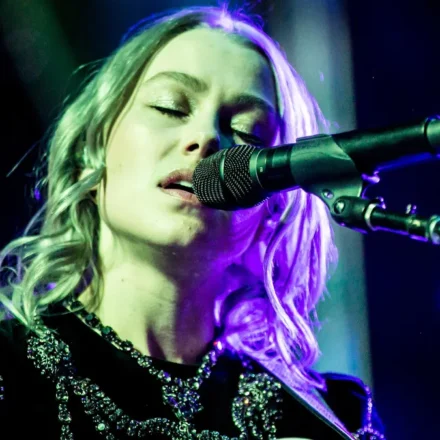
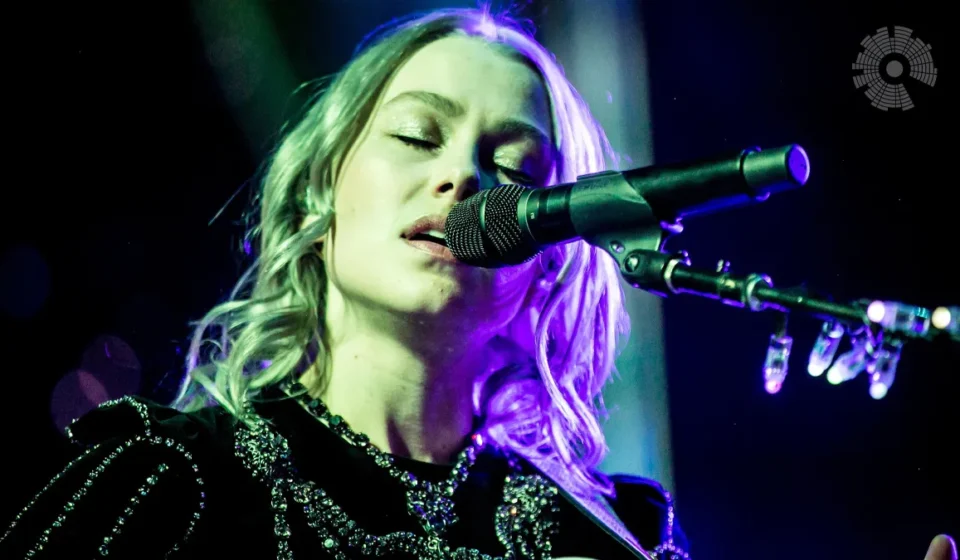
Phoebe Bridgers walked out into a wash of blacklight like she had stepped into a memory rather than a spectacle. Sitting down on a couch that looked more suited to a dim basement than the center of Madison Square Garden, she offered a soft “Surprise,” before easing into a fragile, stripped-back version of “Motion Sickness.” Reclined, guitar resting across her torso, she looked less like a headliner commanding one of the world’s most iconic arenas and more like someone idly strumming through a late-night hangout, half-present, fully absorbed in the song’s emotional weight. That posture—casual, unguarded, almost private—became the defining visual language of the evening.
The “surprise,” of course, wasn’t her presence but the scale—or rather, the deliberate shrinking—of the entire experience. The audience consisted of ticket winners selected through small donations to Community Justice Exchange’s Immigration Bond Freedom Fund, a last-minute pop-up announced only days earlier. What might have been a typical arena spectacle instead felt intentionally inverted: a stadium-sized space engineered to feel intimate, even fragile.
Much of that intimacy was enforced before the show even began. The event was fully phone-free, with strict restrictions on devices including cameras, smartwatches, and any means of digital recording. Entry required sealing personal electronics into Yondr pouches, slowing the flow of thousands of attendees but ultimately preserving the show’s insulated atmosphere. Even journalists were barred from taking notes, a rare attempt to prevent the performance from immediately dissolving into online fragments. The result was a carefully constructed digital silence—an enforced absence that shaped how the night would be remembered: only by those physically present.
Inside the arena, the staging reinforced that sense of contained closeness. The setup was minimal: a handful of blacklight posters, small ambient props, and a looping screen displaying song-specific visuals—ghostly, nostalgic images that flickered like half-remembered scenes. Christian Lee Hutson and keyboardist Nick White provided sparse accompaniment, reinforcing the stripped-down architecture of the performance. Even in a venue built for scale, the production refused expansion, choosing restraint instead of grandeur.
The absence of phones transformed the audience itself. Without screens held aloft, attention settled differently—less fragmented, more collective. Applause followed each song with unusual clarity, and even distant sections of the arena seemed unusually focused, as if the lack of documentation had sharpened perception. A casual shout of “Let’s go Knicks” briefly broke the stillness, but otherwise the crowd remained unusually restrained for a space of that size, responding more like a small-room audience than a stadium one.
The setlist itself blended familiarity with experimentation. Alongside established material, Bridgers introduced several new songs, some performed live for the first time. The unreleased work hinted at an expanded sonic palette: more dynamic shifts, broader emotional arcs, and arrangements that stretched beyond her earlier, more minimal approach. Some songs carried the cadence of late-’80s and early-’90s singer-songwriter traditions; others leaned into chanted climaxes or country-inflected phrasing, suggesting a willingness to step outside her established emotional register without abandoning it.
Even in its quietest moments, the new material seemed to build outward, often cresting into subtle crescendos driven by restrained percussion and layered vocal textures. The effect was not one of volume, but of gradual emotional accumulation—songs that expanded inward rather than outward, pulling focus rather than demanding it. At times, she shifted between instruments mid-set, altering vocal delivery and tone to reshape the atmosphere of each piece, reinforcing the sense that this was not a fixed performance but a living draft of future work.
What emerged most clearly was Bridgers’ evolving relationship to scale. While the venue was massive, the performance resisted the logic of spectacle. Instead of maximizing visibility or spectacle-driven moments, the show minimized itself within the space, creating an unusual tension: the largest possible room hosting one of the smallest possible performances. That contradiction became the show’s central idea—intimacy not as a setting, but as an active construction.
In that sense, the phone-free policy was not just logistical but philosophical. By removing the ability to record, replay, or instantly distribute, the performance resisted the typical lifecycle of modern concerts. It existed only once, in that room, for those people. No clips, no leaks, no delayed viral fragments—only memory as documentation. The absence of digital residue became part of the experience itself, shaping how presence was felt in real time.
As the night closed, it became clear that Bridgers is moving toward a paradoxical artistic direction: expanding her reach while deliberately constraining her footprint. Bigger rooms, quieter mechanics. More attention, less replication. A kind of controlled intimacy performed at scale. And in doing so, she reframes what it means to fill an arena—not with noise or spectacle, but with attention itself.